


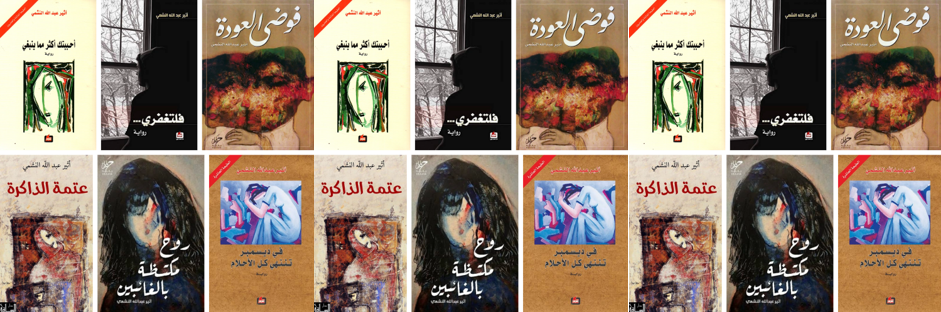
Atheer al-Nashmi: When Love Becomes Both Adversary and Judge
Teenage romances, or an imaginative pattern?
By Mohsen Al-Wayili
Asked once whether any of her novels were an autobiography, the Saudi novelist Atheer al-Nashmi told the daily al-Eqtisadiah in 2016: “I am not so naïve as to write my life into a novel. But into every novel I write, and every novel I will one day write, I put something of myself and about myself.” Years later, when the same confusion between the novel and its author resurfaced, she told Al Majalla that “there is an exaggeration in projecting the experiences of my characters onto my own,” adding, with something like pride: “My consolation is that my work is convincing to that degree.” Between the admission that something of her lives in the novels and the warning against reading them as literal memoir, the writer opens, perhaps unwittingly, the very door through which any serious reading of her world must enter: what seeps into the work may not be al-Nashmi’s life story, but it is a pattern in the imagination—an obsession that keeps returning, a particular way of seeing love, wounding, and absence.
Read the six novels in sequence and you will believe her on both counts. You will not find her life among them, but you will find a single obsession repeating with striking insistence: a wounding attachment from which there is no deliverance, two selves trading the roles of the one who wounds and the one wounded, neither healing from the other, neither quite able to leave. The names, voices, and cities change; the wound stays at the center, as if the writer were circling a question she has not finished with: why does a person remain bound to the one who hurt them?
The line of Jumana and Aziz runs through four novels—I Loved You More Than I Should Have, Forgive Me, The Chaos of Return, and A Soul Crowded with the Absent—while All Dreams End in December and The Darkness of Memory open two parallel angles: one on love under tribal pressure, the other on the wound older than love itself, the wound of the house and the mother.
In I Loved You More Than I Should Have, Jumana bends over letters she writes to Aziz, a man she knows, deep down, will never answer. She writes, certain that words will change nothing, and still she does not stop. She writes to the very man whose hands she once described in one of those letters: “I feel as if you are strangling me with your strong hands.” In that narrow distance—between a hand of hers that writes and a hand of his that strangles—we find the clearest way into al-Nashmi’s world.
Nor does the story end with Jumana. Under different masks, the six novels probe a single wound from its different angles: a self that asks to be seen through love, a man who promises and then flees, an absent one who, even after leaving, holds more power to judge than anyone present. And even when the wound seems older than love—as in The Darkness of Memory, where the maternal wound precedes the arrival of every later beloved—it still orbits the same question: how does a self take shape when it was denied that first act of being seen, and then spends a lifetime asking for it?
Commercial Fiction, or a Human Obsession?
This insistence on the one wound invites a predictable objection that cannot be easily dismissed. Al-Nashmi is among the most widely read of Saudi novelists; I Loved You More Than I Should Have appeared in 2009, in the literary climate that followed the sensational debut of Rajaa Alsanea’s Girls of Riyadh, when the Saudi novel opened wide to women’s voices and to questions of love, the body, and surveillance. Her novel rapidly went through multiple printings. A novel read so widely tempts the skeptical critic to say that this imaginative pattern is a commercial formula recycled because it sells: impossible love, an unfaithful man, abundant tears, and teenage readers buying the same wound under every new cover.
Reading the novels in sequence answers this objection from the inside. The commercial formula repeats the plot and leaves the question where it found it; this body of work ripens its question from one novel to the next. It starts with a complaint—Jumana’s unanswered letters. Then the accused himself is given the floor in Forgive Me to plead. Then The Darkness of Memory digs deeper, excavating beneath love altogether for the wound that preceded it. Next, The Chaos of Return brings the man back, too late, to a reckoning with the past. Finally, A Soul Crowded with the Absent arrives at the moment of decision, when a woman calls her need by its name and closes the case with her own hand. Ready-made formulas know nothing of this; it is the biography of a question as it matures, and it is what separates an artistic obsession from a commercial device.
To defend the depth of this body of work is not to exempt it from artistic scrutiny. Al-Nashmi’s prose drifts, at times, toward direct emotional declaration, and some passages lean into sentimental explanation beyond what the art requires. But these lapses touch the surface of the sentence without reaching what lies beneath it; the value of this fictional world rests in the consistency of its obsession before the polish of its style—and that consistency is what the reading that follows sets out to trace.
Love as a Plea for Recognition
What these selves ask for is something beyond happiness: to be seen. The sentence that distills Jumana’s world goes past a lover’s complaint of separation toward something like an audit, a reckoning of what was paid out and never collected: “I loved you more than I should have, and you loved me less than I deserve.” Love here is a scale, the relationship a lawsuit, the beloved a debtor who never settled. And whoever loves in this way is looking less for a partner than for a witness: someone to certify that the scales never balanced—that she deserved more than she received.
The same plea becomes explicit years later, in A Soul Crowded with the Absent, when an older Jumana returns to name what she could not name in her youth: her first need was not to be loved; it was to be seen by the man as she is. When that recognition never comes, the love does not die—it hardens into a waiting without end, because leaving would mean conceding that she was never seen at all: a weight greater than the wound itself.
And because recognition is what is sought, the woman’s body stands threatened with remaining invisible. At a turning point in I Loved You More Than I Should Have, Jumana describes herself as feeling “like a ghost, unseen.” The whole story is an attempt to cross from that ghostliness into visibility—even if the crossing comes too late.
The Dominion of the Absent
In these novels the absent outweighs the present; the man who has left fills the room more fully than he did while in it, his presence endlessly deferred. That deferral reaches its furthest point in A Soul Crowded with the Absent, when Jumana calls Aziz after years—not hoping to reclaim him, but to face the absence at last. She asks whether he still remembers her, and, “in a voice trembling and choked with tears,” he answers: “I no longer remember you.” A man who denies while weeping has not really left; he is attempting the last available form of presence—to claim he has forgotten, so that the forgetting itself may stand as proof of what was never forgotten.
The Tribunal of Forgiveness
These novels look like novels of love and parting; at their depth they are novels of trial. Every voice in them pleads a case. The very title Forgive Me is an imperative dressed as entreaty, and the novel makes the trial a complete architecture: Abdulaziz (Aziz himself) spends the entire novel building his defense, confessing in order to exonerate himself, explaining his betrayal so that it appears comprehensible rather than culpable. Forgiveness here is more than a quiet virtue; it is a forum of negotiation over the very meaning of the offense: was it betrayal, or weakness, or fate, or a habit beyond resisting? When he says, in I Loved You More Than I Should Have, that he grew used to emptying his heart “to a pure woman in the body of a whore,” he is not so much confessing a sin as advancing a theory of his own innocence: infidelity as habit rather than choice.
Yet forgiveness here is never granted whole. It hangs suspended, a verdict postponed forever. The woman pardons to keep the beloved, only to discover that her pardon has not closed the case. She returns, forgives again, and waits for an admission that would give her forgiveness its meaning—and it never comes. Love becomes a standing hearing in which no one acquits anyone and no case is ever closed.
The tribunal pursues its defendants even to the edge of escape. In The Chaos of Return, Abdulaziz—back in Riyadh at forty, on the verge of marrying another woman—performs the istikhara, the prayer for guidance, for the first time in his life: not in calm surrender to fate but in secret hope that “the hand of God” will intercept him and halt a marriage he does not want. Even at that threshold he cannot pass judgment on himself; he summons a higher arbiter to decide what his own will cannot settle.
This tribunal is, in the Abbasid poet al-Mutanabbi’s phrase, the condition in which the beloved becomes an adversary and a judge at once: “O most just of men—except in your dealings with me: the quarrel is over you, and you are both the adversary and the judge.” The heart complains to the very one who broke it. And because the pattern recurs through different men and different voices, the quarrel lies not in this beloved or that, but in love itself: when the man changes and the trial remains, we understand that the tribunal is the structure of this love, not an accident of one of its parties. Once the one we love becomes at once our adversary and our judge, love has no horizon left but to remain an endless trial—because its verdict is entrusted to the one who benefits most from never ruling.
The Man: A Lover and a Wounding Power
The man in these novels is not a villain, and there lies his danger. He is a true lover and a wounding power in the same body—a hand that caresses and strangles. He excels at making a woman feel she is the center of his world, then at making her doubt her own existence. His flight is a psychic structure: whenever he nears arrival, he bolts at the threshold. In Forgive Me, Abdulaziz reveals what he is running from when he confesses that a woman’s overwhelming femininity “exhausts my manhood.” He flees the surplus of love, not its lack—flees a woman whose sheer presence threatens a brittle masculinity that finds calm only when it keeps between itself and the woman a distance it controls.
Because an equal presence threatens him, the man can bear desire only when he converts it into sovereignty. In All Dreams End in December, Hadham describes the moment of union as a conquest rather than a meeting: “I feel I have conquered the world and made it mine.” The woman he adores he turns into a creed—a woman of whom it is said “you are his religion, and he has no religion but you”—and then he savors her very piety, watching her pray after a night of forbidden pleasures. To own her, to deify her, and to indict her in the same breath: these are his three stratagems for never having to stand before her unarmed, equal to equal.
And when the woman attains full equality, all his stratagems collapse. In The Chaos of Return, Abdulaziz confronts a Jumana who has become what cannot be owned, deified, or indicted: a grown, independent woman who has realized herself far from him. He admits that her husband resembles her, and not him at all—and in that mirror he sees his own negation: a man who stands beside her as a peer, not as a power over her. Here his brittle masculinity is stripped bare. The woman who once “exhausted his manhood” by her presence now threatens him with something beyond the surplus of her femininity: with her completeness, which leaves him no place. He was never afraid of losing her; he was afraid of standing before her exposed, with no stratagem left to hide his inability to be her equal.

The Woman: A Self, Not a Victim
It is easy to read these women as victims, and that reading falls short. Jumana is not blind to what Aziz does to her; she sees the wound, but stays, because in staying there lives the wait for a recognition that never came. She returns to him after the betrayal knowing she is choosing a man who will not change—undeceived. That awareness lifts her from the rank of victim to a more complicated station: a woman who knows the price of her staying and pays it.
The completion of this arc is witnessed from the outside, in The Chaos of Return, where Aziz himself testifies to what she has become: a woman who holds a doctorate, heads an association, has built a family, and has chosen a partner to stand at her side. The man who once believed himself her center discovers she has moved on and left him at the margin. And such is the elegance of the design that the testimony to her independence comes from the man who lost her, not from her own mouth: the woman who spent the whole corpus asking to be seen is finally seen when she has stopped asking to be seen.
In A Soul Crowded with the Absent, this knowledge becomes an act. The woman chooses the break by her own will—not because she has healed, but because she has decided to stop. What changed hands is the grip on the wound, not the wound itself. She no longer waits for the absent man’s admission; she is now the one who hands down the final verdict, painful as it is. And this is the truest thing in these novels: instead of a false salvation, they grant the woman something worth more—authority over her own wound.
The Body Between Desire and Surveillance
The body in these novels is a site of desire and of surveillance, and the two cannot be pried apart. Desire is vividly present—in Jumana’s gaze at the veins of Aziz’s hands, in the man’s confession of his thirst for her—but it is never spoken without first wrapping itself in whatever might absolve it: even truth is measured against the covered body when Jumana writes that “truth is a nakedness we all strive to cover.” And the censor is internal before it is external, the voice of a society so settled into the self that it passes for the self’s own voice. When the two lovers hide their identities on the phone in a crowd, and when Jumana reaches for the Syrian poet Nizar Qabbani’s line to describe a love lived “by smuggling and forgery,” it becomes clear that the censor has moved from outside the house into the chest itself—and desire emerges heavy with guilt even when no one knows of it but its owner.
The First House
Before love was a tribunal, the first house was a smaller one. The Darkness of Memory parts ways with its sisters in that the wound begins in a house that was never a refuge: only in adulthood does Mashhour understand that his mother had been “the great knot in each of our childhoods,” and the body itself turns there from a site of desire into a site of beating—a child’s thin body under his mother’s blows. Whoever was denied a safe embrace in childhood goes looking for it in the woman he loves, as Mashhour searches for “a woman who does not resemble my mother”; but no single woman can be the substitute mother and the adult partner at once, and the first abandonment repeats. Nor does the father’s wound stay confined to one novel. In The Chaos of Return, Aziz stands before his aging father and discovers in the mirror that he has come to resemble “the father who pushed me away,” in his own phrase—his flight an orbit around the same center; and a man who has spent his life fleeing a first authority may well stumble when love asks him to stand as an equal beside a woman who arrives complete. A kinship glimmers here between the two wounds: the plea to be seen may be, in one of its forms, the extension of a plea for a safe maternal embrace that never was. In the Jumana novels this remains a possible illumination, not an established verdict—but the recognition demanded of the beloved carries the tone of an older need: that someone see you with a gaze that does not wound.
The Judge Who Migrated Inward
This private wound has a public root. The censor that polices desire from inside the chest is itself a wider social order that has migrated into the self and become its conscience. In All Dreams End in December, Hadham loses his beloved because his father, as he puts it, “fell in with the tribe’s procession and barred me from happiness”—and when he then flees love, he flees in obedience to an authority that now lives inside him. The shackle keeps working after its cause is gone: the self in A Soul Crowded with the Absent confesses that she did not fear freedom while deprived of it; she feared it when it landed in her hands, because freedom means facing desire without a judge to justify or condemn it. The oppressed becomes the warden of her own oppression. And the corpus reaches the peak of its self-awareness when it calls the system by its name, observing that the women of its society are, more often than not, “guaranteed to stay.” What we had been reading as a private complex—the woman’s remaining inside her wound—stands revealed as a social structure: her staying is guaranteed in advance, and that very guarantee is what makes wounding her cost nothing.
Writing as Final Witness
There remains the fact that all of them write. Jumana writes her letters; Abdulaziz writes his columns and confessions; Mashhour retrieves his childhood from inside his darkness. Writing, for these characters, is testimony before it is confession—a last attempt to keep the absent one from a total victory.
What life could not grant—recognition—writing manufactures outright. When Jumana writes to Aziz she is not waiting for his answer; she is establishing, before a blank page, that she was there, that she was never a ghost. The page grants her what the beloved could not: to be visible. And when the man confesses on paper what he dares not say in life, he is pleading before a court more merciful than the court of the real.
Most of these novels rest on the form of address to an absentee—the voice of someone calling out to a person who cannot see him, to make sure he exists. The form finds its purest expression in The Chaos of Return, where the entire novel unfolds as an address to the absent Jumana who will never read it: Aziz writing what he dares not send. And in this lies the explanation for al-Nashmi’s returning to the same wound: she is raising her question again, not writing her memoir. Why does a person remain bound to the one who wounded them? Because from no one else will they accept the testimony that they deserved more than they received. That is the tragedy of this fictional world, and the secret of its truthfulness: it knows that the harshest thing ever asked of love is to bear witness—not to endure.
A note on method and quotations: This reading draws, in its background, on Charles Mauron’s psychocriticism—reading a writer’s works together to track recurring images toward what he called the “personal myth”; “a pattern in the imagination” is a phrase derived from that horizon, not Mauron’s own term. All passages from the novels are quoted in my own English rendering from the electronic editions listed below, as are the English titles, no official translations of which I am aware. Al-Mutanabbi’s line is cited from the classical tradition; Nizar Qabbani’s phrase is quoted as it appears within I Loved You More Than I Should Have. The author’s statements are from her interviews with al-Eqtisadiah (June 9, 2016) and Al Majalla (March 1, 2025).
Editions consulted: أحببتك أكثر مما ينبغي (I Loved You More Than I Should Have), Dar al-Farabi, 2009; في ديسمبر تنتهي كل الأحلام (All Dreams End in December), Dar al-Farabi, 2011; فلتغفري (Forgive Me), Dar al-Farabi, 2013; عتمة الذاكرة (The Darkness of Memory), Dar al-Saqi, 2016; فوضى العودة (The Chaos of Return), Dar Hikaya, 2021; روح مكتظة بالغائبين (A Soul Crowded with the Absent), 2024.
Mohsen Al-Wayili is a Saudi writer and translator working at the intersections of literature, philosophy, and psychology. You can contact him at molmohsen@pm.me or follow him on twitter @molmohsen.