

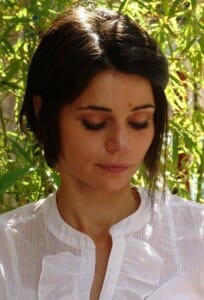
It was a disservice to the Syrian people (as well as the woman pictured left, whose identity was appropriated), and a particular disservice to GLBT Syrians as well as Tal and other blogger-poets who really have been imprisoned by the regime in Syria and who really could use the mobilization of international support.
Arrests of real bloggers began long before the current protests. Young Tal al-Mallouhi, who was arrested last year, was sentenced to five years in prison this February, supposedly for “divulging information to a foreign state.”
Ghias Aljundi translated one of Tal’s poems, “You will remain an example,” for PEN International. The poem, dedicated to Gandhi, opens:
I will walk with all walking people
And no
I will not stand still
Just to watch the passers by
This is my Homeland
In which
I have
A palm tree
A drop in a cloud
And a grave to protect me
Also this week, over at Jadaliyya, Gaelle Raphael has translated an essay by celebrated Syrian poet Nizar Qabbani (1923-1998). I don’t believe Qabbani spent any time in prison, although his father was imprisoned a number of times for his support of the resistance to the French mandate.
Here, Qabbani criticizes the Arab civil-servant poet, asserting that poets need to declare their independence from their states. He writes (trans. Raphael):
Writing is a daily game with death. Thus Hemingway understood literature, and thus Kafka, Lorca, Camus, and Mayakovski, and others who have lived their lives and writings in the isthmus between life and death.
And all this reminds me of Qabbani’s poem, “A Lesson In Drawing,” (translator not credited!) which begins:
My son places his paint box in front of me
and asks me to draw a bird for him.
Into the color gray I dip the brush
and draw a square with locks and bars.
Astonishment fills his eyes:
‘… But this is a prison, Father,
Don’t you know, how to draw a bird?’
And I tell him: ‘Son, forgive me.
I’ve forgotten the shapes of birds.’
Read more: