

Ayman Fadel at Balagh Translations has been looking at the translation of popular science books into Arabic; he’s found that there are, among other things, a number of unauthorized Carl Sagan translations making their way around the web. He asks:
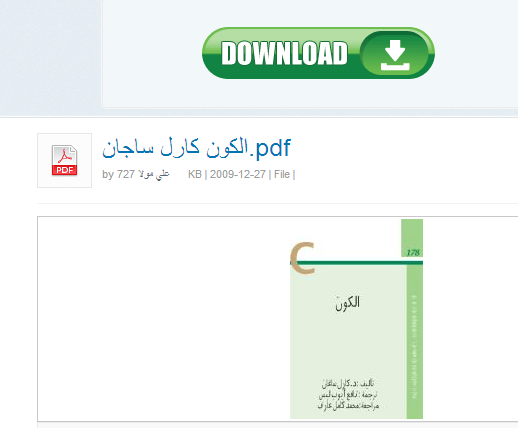
As Fadel said in a follow-up email, the question isn’t really about unauthorized translation (I could translate all of Lev Tolstoy from the comfort of my living room without bothering a gol-darned soul), but about unauthorized distribution of unauthorized translations — violating copyright, that “sacred cow of Western publishing,” as Pieter Steinz, director of the Dutch Foundation for Literature, called it yesterday.
Surely, in a world of evenly distributed resources, unauthorized translations would never be okay. We would not want, after all, a translator to take a fancy to Taher El-Sharkawy’s He Who Raises a Stone in His House, translate it into English (or Icelandic or Turkish or Dutch), publish and distribute it without the author’s consent, oversight, or giving El-Sharkawy or Kotob Khan Books a single piaster.
But what about Arabic translations of, for instance, scientific works, which are so lacking? Fadel said, in email:
Overall, I think it is morally justified to the extent there is value in the work being translated and the translation and distribution are of sufficient quality to maintain the work’s value. For popular science books, in an age where technological and ecological issues should dominate public policy concerns, I see these books in the same way I see generic versions of medicines. Just as it’s not right for a multinational pharmaceutical company to stop India and Brazil from producing life-saving medications at prices people can afford, it’s not right for Routledge to deny people access to knowledge.
