

Demand for Dorit Rabinyan’s Borderlife has apparently surged since the novel was excluded from Israel’s high-school Hebrew-literature curriculum for the Jewish-Muslim love story at its center. Sarah Irving, who wrote her Masters thesis on the depiction of Muslim-Jewish and Jewish-Arab romances in novels written in Arabic or by Arabs — joins the discussion:
By Sarah Irving


The Israeli newspaper Ha’aretz quoted the reasons stated by the ministry for removing the book from school reading lists: “Young people of adolescent age tend to romanticize and don’t, in many cases, have the systemic vision that includes considerations involving maintaining the national-ethnic identity of the people and the significance of miscegenation.” The book was further deemed to “threaten Jewish identity.”
Miscegenation is defined by Merriam-Webster as: “a mixture of races; especially: marriage, cohabitation, or sexual intercourse between a white person and a member of another race.” And a is book removed from school curricula because it suggests that a Jewish woman might fall in love with, and have sex with, a non-Jew, and that that might not be a bad thing. This is where the current Israeli administration is coming from.
Predictably enough, the web’s Muslim-haters have gotten in on the act, with comments like this:
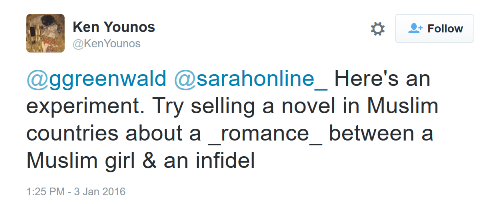


Now, I don’t know how many books there are in Hebrew which depict Jewish-Arab relationships (I can think of at least one other, written by an Arab). But I know for certain that the idea that Arabic-speaking, Muslim-majority countries wouldn’t publish a book with this theme, and that there would be “worldwide riots” in response to it, is, to use a colloquialism, bollocks.
That’s not to deny that the theme of Muslim-Jewish interaction can sometimes attract controversy – as in the recent Egyptian Ramadan TV serial Harat al-Yahud (The Jewish Quarter). In that case, however, the issues seem to have been about Egyptian-Israeli politics rather than the positive portrayal of Egypt’s Jewish community itself.
A couple of years ago, I wrote my Masters thesis on the depiction of Muslim-Jewish and Jewish-Arab romances in novels written in Arabic or in other languages by writers of Arab origin. And there are more examples than you might think.
The list I compiled numbers over forty titles, starting in 1919/1920 and rising dramatically in number since the late 1980s (The scholar Najat Abdulhaq, meanwhile, says the rise in representations of ‘the Arab Jew’ in Arabic fiction has risen more recently). The books on it come from all across the Arabic-speaking world, from Yemen and Saudi Arabic, Iraq, Palestine, Lebanon, Egypt, Libya and Algeria. The stories are historical and contemporary, have sad or happy endings, are sexy or prim, massive tomes or slender novellas, have men or women as the Jewish/Muslim character, have the romance as a central theme or not. In short, there is huge diversity.
To illustrate that diversity, richness and breadth of themes, here are just a few examples (ones available in translation, given the main focus of this blog):
- Egyptian novelist and academic Bahaa Abdelmegid’s novellas Saint Theresa and Sleeping with Strangers, published in a single volume by AUC Press (translation by Chip Rossetti), tell two very different stories in which relationships between non-Jewish Egyptians (some Muslim, some Christian) and Jewish characters are pivotal to the plot. For other takes on the theme of ‘Egyptianness’ and the complexities of identity, there is also Waguih Ghali’s under-rated 1964 classic Beer in the Snooker Club (original in English) and Kamal Ruhayyim’s excellent Days in the Diaspora and Diary of a Jewish Muslim.
- Two very different novels about Palestinians in Lebanon feature small sub-plots of Jewish-Arab couples as a symbol of background hope and possibility against a contemporary narrative of violence and despair. Elias Khoury’s mighty Gate of the Sun (translated by Humphrey Davies) mentions Jewish women who married Palestinian men and ended up living in refugee camps in Gaza; Mischa Hiller’s Sabra Zoo (English original) uses the same motif, this time in Beirut. Rabai al-Madhoun’s mystery The Lady from Tel Aviv (translated by Elliott Colla) and Samir el-Youssef’s A Treaty of Love (English original) are other examples of Palestinian writers taking on the possibility of love between Palestinians and Israeli Jews.
- Several of Amin Maalouf‘s novels (all originally written in French), including Leo the African, have sub-plots which involve Jewish-Arab or Muslim-Jewish lovers. These very much slot into Maalouf’s interest in the idea of diverse Mediterranean identities, of which Jewish and Arab are just two. More significant in relation to the theme, though, is Ports of Call, set in the early twentieth century and with a plot that revolves around a couple divided by the foundation of the State of Israel.
- Mahmoud Saeed‘s bittersweet coming-of-age tale The World Through the Eyes of Angels, the protagonist of which falls in love with his Jewish friend’s sister in the Iraqi city of Mosul, only to lose her when the family emigrates to the newly-founded State of Israel. The translation, by Samuel Salter, Zahra Jishi, and Rafah Abuinnab, won a King Fahd Center award for Middle East and Islamic Studies Translation of Arabic Literature. Khalid Kishtainy’s By the Rivers of Babylon and Ali Badr’s fascinating and complex The Tobacco Keeper (translated by Amira Nowaira) also tackle the complex position of Iraq’s Jews in the mid-twentieth century.
Of course, this list could also include Yemeni novelist Ali al-Muqri’s The Handsome Jew, if any publishers out there fancy picking up my translation of it.
To make a more direct comparison with the Israeli case; I have no idea whether any of these books have ever been considered as set texts for schools in the countries in which they were written or published. But their existence, and that of TV series’ and films with similar themes, indicates that at the very least the idea is very much not beyond the (literary) pale.
