New Egyptian ‘House of Translation’ to Launch October 31
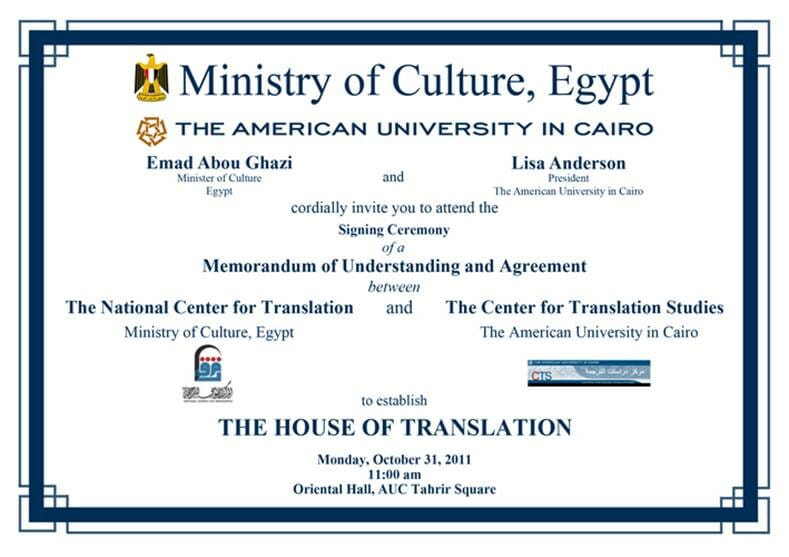 On Halloween morning, the American University in Cairo’s (AUC) Center for Translation Studies and Egypt’s National Center for Translation are set to launch a joint project, a new House of Translation (بيت الترجمة).
The translation center’s Director Samia Mehrez said that they are “very happy to enter into this partnership, of course. As two centers, I think we complement each other in many ways.”
She noted that the National Translation Center’s focus is on the practice of translation, whereas her center concerns itself with theory. The “House of Translation” is the first joint project in what may well grow into a series of such collaborations.
The House of Translation’s initial mandate is to host three translators or translator-scholars each year in three consecutive sessions. Potential visiting scholars will apply to an open, worldwide call.
“Obviously this is multidisciplinary—humanities, social sciences, literature, but also the sciences,” Dr. Mehrez said. “I’m looking forward to seeing applications in the sciences. This is an area that both centers need” to focus on more.
The project must be Egypt-oriented in some way, Mehrez said, so that the visiting translator will benefit from time in the country. The translator or translator-scholar will also have an opportunity to get feedback from Egyptian colleagues. And Egypt will benefit from the translator’s presence, as the House of Translation residents will be asked to give lectures and workshops.
Who can apply for the residency?
“There are translators, people who are working on various texts that have to do with Egypt in particular,” Mehrez said. “But also scholars working on manuscripts in translation studies. And the field is immense. Historians, anthropologists, literary critics…. The field of translation studies is a traveling field.”
Mehrez said that the call for applicants will go up on both centers’ websites. “We would also like to think of our local translators in Egyptand in the region.” But, she added, “it would be wonderful to have scholars from China and Japan, Turkey, Iran.”
October 27, 2011 @ 8:22 am
Is it confined to Arabic translators?
October 27, 2011 @ 8:59 am
No, but there must be “a common language,” she said. So no Slovenian-Xhosa translators, I guess.
October 27, 2011 @ 12:08 pm
but slovenian-klingon is fine. i checked.
October 27, 2011 @ 12:24 pm
Don’t you appreciate how I always use Slovenian as my example of a small language?
October 27, 2011 @ 1:19 pm
actually … but as long as you emphasise every. singe. time. how pefectly formed it is, how precise and oooh, and aaah, we’re good. 😉
October 27, 2011 @ 11:39 am
My suggestion is that a giant project on translating modern sciences from all world languages into Arabic is what we need today.
October 27, 2011 @ 12:24 pm
I’m with you, Dr. Mahmoud.
October 27, 2011 @ 12:41 pm
Hm, and now I recognize that—while there seem to be NUMEROUS calls from Western governments/persons to translate humanities and literature into Arabic—I have never heard calls for translating science.
October 27, 2011 @ 9:46 pm
Answering mlynxqualey, I think the reason is that science tends to travel faster these days in the form of its technological products while literature and humanities, the abstract idea, the psyche are slow to come.
Ma che traduzioni d’Egitto! | Tropico del Libro
October 28, 2011 @ 7:35 am
[…] Fonte | Arablit.wordpress.com […]
October 28, 2011 @ 9:31 am
Dear All,
My Name is Mohammed A. Al Sha’rawi. Currently, I am working in Oman as an English Language Instructor at one of the universities and I have been a freelancer translator for over 16 years. I believe we are in pressing need to have more and more of the thousand books translation project with more emphasis on science. Unfortunately, we are far behind in this domain. Translation has proven to be a major factor of building up and developing various aspects of civilization. I believe that all we need is to have clear policies regarding what our priorities are and start working towards them.
October 29, 2011 @ 2:37 pm
Mohammed,
Another question is…if they are translated in Egypt, will they be easily available across the region?
Inaugural HOT Lectures on Global Perspectives on Translation, Translation in Digital Age | Arabic Literature (in English)
December 22, 2011 @ 6:59 am
[…] I hope I’m not the only one who’s going to be using this acronym for Egypt’s new House of Translation. Share this:TwitterFacebookEmailPrintStumbleUponLike this:LikeBe the first to like this post. […]