
Arab Authors and ‘Writing for Translation’
ArabLit reader and scholar Nesrin Amin sent me the passage below yesterday, which she says is from Tim Parks’ Translating Style:
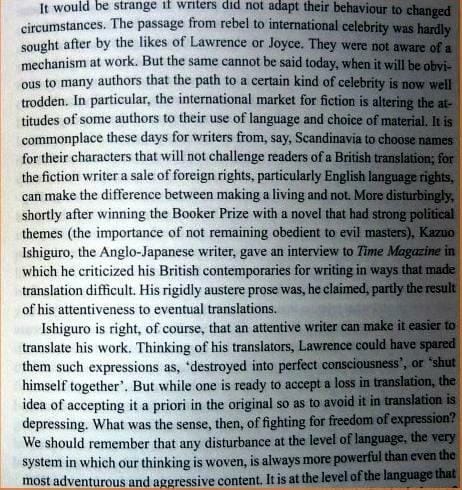
Palestinian poet and memoirist Mourid Barghouti has written about the phenomenon of Arab authors writing toward translation into Western languages, presumably in somewhat of an Ishiguro-like manner. Others have written about this process of (apparent) literary homogenization, which may or may not be negative, as Rebecca Walkowitz discusses here.
It also occurred to me, somewhat belatedly, that Arab authors are experts at a certain sort of writing “for translation,” as fos7a (literary Arabic) itself is a sort of pan-Arab translation from the colloquial mother tongue. Ergo, (many) Arab authors already adapt their language quite significantly to reach a larger intended audience.
Some are going the opposite direction, against the global grain, writing novels and literature in colloquial Arabics, adapting to a more local language and audience.
Is it “wrong” to write for global audiences? I imagine that, for those particularly interested in Western prizes and Western audiences, or in writing back to Empire, most take the direct route: writing in English or French. Otherwise, it becomes necessary to craft one’s writing for a pan-Arab audience (and a fos7a-trained translator) and then to further fine-tune for Western-language adaptation? It would require a pretty good control of style, I guess.
On the other hand, authors choosing topics to appeal to Western audiences is a different, and smellier, kettle of fish.
June 11, 2012 @ 2:12 pm
Jenine Abboushi Dallal wrote a brilliant article on Arab writers and the possibility of shifting readerships: “The Perils of Occidentalism: How Arab Novelists Are Driven to Write for Western Readers.” The Times Literary Supplement, April 24, 1998. Other translators of Arab works had also commented on translating Arab writes as linked to market considerations. Miriam Cooke is one of them.
June 11, 2012 @ 2:38 pm
Thanks! I’m supposed to meet with Miriam later this summer; I’ll have to ask her about it.
June 11, 2012 @ 11:05 pm
Interesting post. Makes me think if Ammiel Alcalay’s essay “Limits of tTranslation” and his questioning of the translator’s responsibility & role in the service of a western readership with it’s on agenda.
Arab Authors and ‘Writing for Translation’ | Metaglossia
June 12, 2012 @ 9:32 am
[…] on arablit.wordpress.com Share this:Like this:LikeBe the first to like this post. This entry was posted in NewsPage. […]