When Is It Okay to Distribute Unauthorized Translations?
Ayman Fadel at Balagh Translations has been looking at the translation of popular science books into Arabic; he’s found that there are, among other things, a number of unauthorized Carl Sagan translations making their way around the web. He asks:
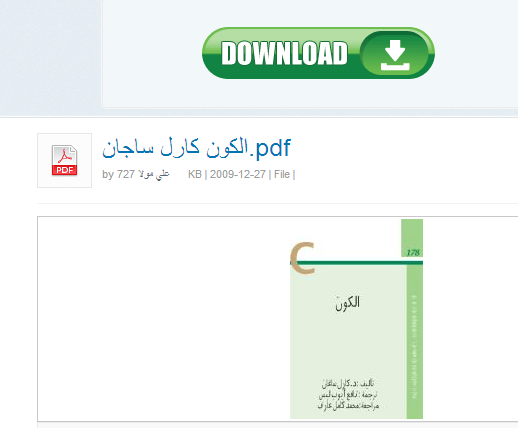 Is unauthorized translation a good thing?
As Fadel said in a follow-up email, the question isn’t really about unauthorized translation (I could translate all of Lev Tolstoy from the comfort of my living room without bothering a gol-darned soul), but about unauthorized distribution of unauthorized translations — violating copyright, that “sacred cow of Western publishing,” as Pieter Steinz, director of the Dutch Foundation for Literature, called it yesterday.
Surely, in a world of evenly distributed resources, unauthorized translations would never be okay. We would not want, after all, a translator to take a fancy to Taher El-Sharkawy’s He Who Raises a Stone in His House, translate it into English (or Icelandic or Turkish or Dutch), publish and distribute it without the author’s consent, oversight, or giving El-Sharkawy or Kotob Khan Books a single piaster.
But what about Arabic translations of, for instance, scientific works, which are so lacking? Fadel said, in email:
Overall, I think it is morally justified to the extent there is value in the work being translated and the translation and distribution are of sufficient quality to maintain the work’s value. For popular science books, in an age where technological and ecological issues should dominate public policy concerns, I see these books in the same way I see generic versions of medicines. Just as it’s not right for a multinational pharmaceutical company to stop India and Brazil from producing life-saving medications at prices people can afford, it’s not right for Routledge to deny people access to knowledge.

February 8, 2013 @ 9:27 am
Another brilliantly provocative post!
February 8, 2013 @ 10:05 am
What about when the distribution involves no exchange of money, the author passed away and nobody remembers her/his work? (and it’s the only published science-fiction found somewhere in North Africa, ahem).
February 8, 2013 @ 5:51 pm
Ahem, NG, I hope the translation found a delighted audience.
February 8, 2013 @ 2:58 pm
I spent years fighting against the endemic software piracy in the Middle East for client the Business Software Alliance. I have watched over the past 25 years as the region’s ICT industry has been retarded and decimated by piracy and I have heard every single debased excuse and argument to support and justify what is, simply, theft.
Knowledge and creativity have a cost and a price and a right to reward. Arguing poverty is debased. I well remember the anger of one Microsoft staffer confronted by a Lebanese family complaining they couldn’t afford MS Office for their son. He replied, in a quiet fury, that an education license for Office was $99 and their son was wearing Nike trainers.
To value his product less than shoes was, in a very Arab way, the worst insult he could bear.
The same is just as true of books. You can afford a book. It’s the author’s right to sell it. In translation or not.
The good news is that ebooks mean authors can go direct to market for a fraction of the paper price. Where they do, piracy becomes a marginal consideration – the act of theft isn’t worth it.
February 8, 2013 @ 3:26 pm
anyways, ignoring alexander’s orientalist tripe,
breaking free from copyright and profit based incentive for creation (and modifying others creation) can only benefit humanity. the more we freely share with each other the better we are all off. the answer to the question of compensation is not to become more close minded but to be more open, to find ways to share MORE freely so that we can all benefit together. in other words, fuck capitalism
also, there will clearly be an age gap in the answers here. those who grew up with wikipedia, bittorrent, and anonymous have a different attitude then the older generations who are trying desperately to stop the communism of the internet from impeding on their profits. it’s an age war as much as a class war. anyways they are older, they will die, we will win.
February 8, 2013 @ 6:12 pm
Alexander has a point. The problem of software piracy does exist, but it isn’t the only problem. There are alternatives to this. I’ve been using free MS Office’s alternatives (Open, then LibreOffice) for years. There isn’t much awareness of alternatives.
Knowledge and creativity do have a cost, but not necessarily the traditional way of cost, price, and reward. With the growing number of open-access textbooks (and fairly infinite resource of public domain works), knowledge can have minimal cost for the consumer, and in some cases, legally minimal cost for translators to translate and distribute.
It only becomes easier for these things to be accessible/editable, not only in the original, but also in translation, as more writers (fiction or non-fiction) become willing to license their works in ways that allows that to happen.
Let’s be honest about authors getting paid for what they write, it’s not often that you meet a writer who makes a living from writing. Many, like Alexander McNabb, Cory Doctorow, and countless others, work on other things too, say co-hosting a show on the radio, working on non-writing jobs.
I’m sure writers would be thrilled to see their works translated into other languages, the issue isn’t how writers get there, but rather how writers would allow others to help them get there. Cory Doctorow, for example, licenses his works liberally enough that there are fan-translations out there, and he endorses them and links to them from his website.
It does seem too late for some writers to do that with their works, that’s why the public domain exists. But it’s never too late for writers now to do that with their works.