How To Support Arab Authors?
Last week at Cairo’s Goethe Institute, three German and three Egyptian writers came together to discuss the writing process, its politics, and how to (not) make a living as an author.
Last week at Cairo’s Goethe Institute, three German and three Egyptian writers came together to discuss the writing process, its politics, and how to (not) make a living as an author.
This week, the World Wide Web Foundation (WWWF) came out with its rankings of countries for how they best put the “Web to work” in improving human rights and economic development. Digital has also begun to offer greater access to Arabic books, escaping country-by-country distribution problems. But also last week, an activist from the UAE and a Kuwaiti man were both sentenced to prison time for tweets.
If you’re in Chicago tomorrow, you can join translators Kay Heikkinen and Cameron Cross, academic Michael Sells, as well as novelist Gamal al-Ghitani, for discussions of the transmogrification of classical Arabic literature into modern Arabic fiction — as well as the shape-shifting of this literature from Arabic to other languages.
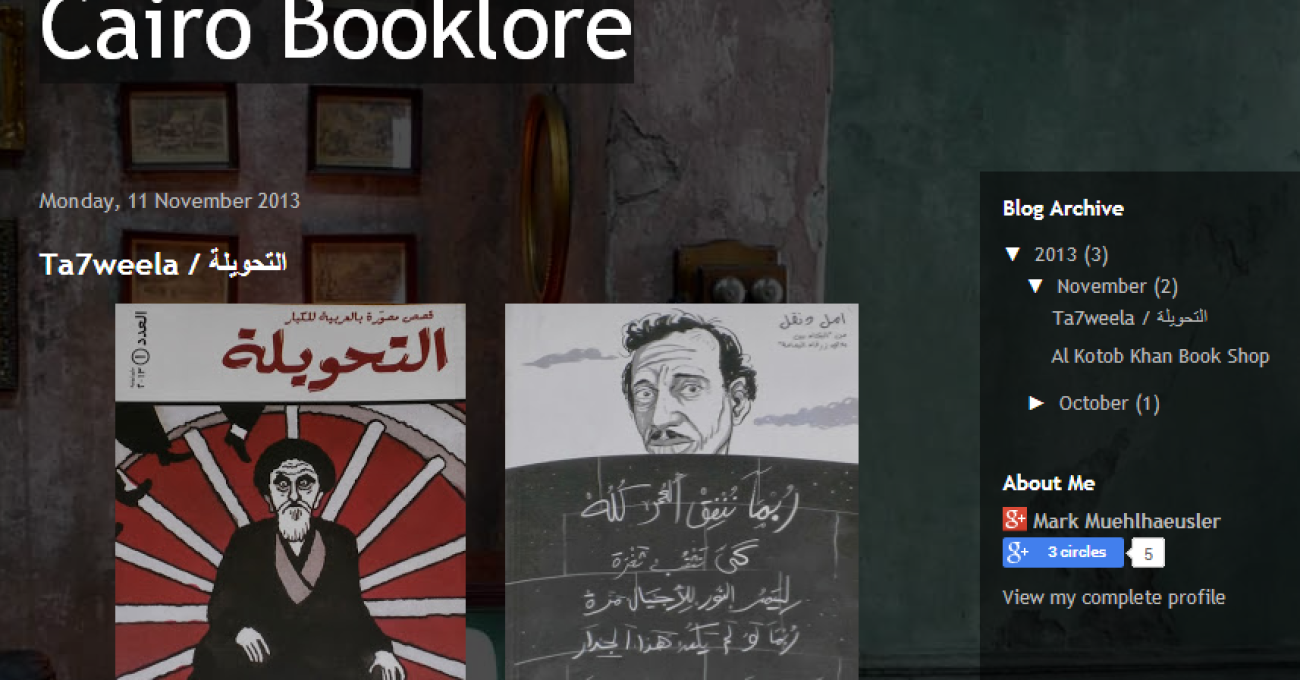
There’s a new Cairo books blog, recently launched by AUC Middle East Studies librarian Mark Muehlhaeusler, called Cairo Booklore.
In Anbara Khalidi’s Memoirs of an Early Arab Feminist: The Life and Activism of Anbara Salam Khalidi, Khalidi spends a fair bit of time discussing her views of literature, magazines, and writers.

In his recent review of the book, M.A. Orthofer called Humphrey Davies’ translation of Ahmed Faris al-Shidyaq’s Leg Over Leg “the most important literary publication of a translation into English, in terms of literary history and our understanding of it, in years.” Davies answered a few questions about the four-volume book in an interview that originally appeared on the Library of Arabic Literature blog.

Tomorrow at noon, eds. Olivia Snaije and Mitchell Albert, as well as contributors Malu Halasa and Steve Sabella, will discuss the powerful collection Keep Your Eye on the Wall at London’s Mosaic Rooms.

A newly released PEN report finds that a large — and perhaps growing — number of US writers avoid or are considering avoiding red-line topics, which include criticism of the US military and the whole of the Middle East and North Africa.
Eight titles were shortlisted for the first-ever ‘Prix de la Jeune Litterature Arabe.’ Douaihy won the prize for his St. George Was Looking Away, trans. Stephanie Dujols ( شريد المنازل).