Yahya Lababidi’s ‘If You Cannot Say Genocide’
Yahya Lababidi’s ‘If You Cannot Say Genocide’
By Nada Hodali
Restrictions have become a normal part of the daily lives of Palestinians. No one bats an eye whenever a new obstacle comes along, for they always find a way to go around it. In Yahya Lababidi’s new book, the obstacle in question is neither physical nor metaphorical: it is calling a thing by its name. It is the sheer fact of saying genocide, of accepting that a genocide is taking place in Gaza.
If You Cannot Say Genocide explores a question familiar to Palestinians: how can they talk about what is happening in Gaza without saying the exact word for it? How can it be stated in such a way that it is both obvious and discreet? Lababidi answers the question with a clear refusal: he insists on saying the word genocide. The book shows how words and language can be warped, how Palestinian art is read, how art and resistance are interconnected in Palestinian society, and how poetry and writing can offer solace.
If You Cannot Say Genocide is Lababidi’s latest contribution to amplifying the voices and stories of Palestinians through his writing, as an Arab-American writer and activist of Palestinian heritage. In 2024, he published the poetry collection Palestine Wail, which recalls his grandmother’s story. Lababidi’s work, though literary, always also carries a political message because of its content. In this new book, he addresses various themes, not limited to language, political literature, and resistance, as a response to the genocide in Gaza and all the catastrophes Palestinians have had to endure, and still endure.
One main point that Lababidi explores is language. He warns of “a corruption of language” and, citing Heidegger’s phrase “language is the house of being,” casts writers as the guardians of that house (p. 12). What troubles him is that words meant to protect people are turned against them, and he uses his own writing and poetry to instead share their stories. This also connects to later chapters that talk about art and witnessing. I do agree that it is important to know how language is going to be used in order to ensure that it will not reflect badly on those of whom it speaks. The goal is to use language to safeguard people, not harm them any further.
If language can be corrupted, art and symbols are ways in which Palestinians have kept meaning honest. Palestinians have always used different methods to signal their resistance in subtle ways. One memory that comes to mind is when Palestinians were banned from carrying the Palestinian flag. They would walk through the streets of Ramallah, Bethlehem, and other Palestinian cities surrounded by clothes in the four colors of the flag hanging on laundry lines. Lababidi describes the same urge in the visual artist Sliman Mansour, who used colored cloth to signify resistance during the First Intifada (p. 50). Palestinians know that the watermelon later took on the same role, its colors echoing the flag’s.
Lababidi shows how both drawing and literature have long been used by Palestinians to demonstrate resistance. But he also notes that writing has been read politically, regardless of what its makers intended. Mahmoud Darwish’s poem “I Long For My Mother’s Bread” was read as allegory, with the mother standing for the homeland (p. 55). Yet Darwish himself calls poetry “the scandalous revelation of my secret” (p. 56), something private before it became public. For Lababidi, poetry is not merely a vehicle for politics; it preserves the soul and spreads peace (pp. 23–24). I agree with Lababidi on this—Palestinians have always used folk songs and music in general to keep going. Songs would be blaring during the olive harvest and family gatherings, music is the thing that keeps us alive and what truly sustains the soul.
Reading Lababidi’s book, one is pushed to examine where one stands on all that has taken place over the years. If You Cannot Say Genocide would intrigue those who are interested in the connections between literature and politics, and the effects of artists’ backgrounds on their writing. I applaud Lababidi for using his platform as a writer to amplify the voices of his people. He connects the use of language to resistance, and both to the way people perceive the art produced by Palestinians. No matter how differently art and writing are perceived, they can still help readers understand the situation.
Nada Hodali is a Palestinian writer and literary translator working between Arabic and English. She holds degrees from Birzeit University and Durham University, BA English literature and MA Translation Studies. Committed to amplifying Arab voices, her work has appeared in journals including ArabLit Quarterly, Mousse, and ANMLY, as well as with Interlink Publishing and TBA21. She has translated authors including Sahar Khalifeh and Najem Wali. Her recent projects include 30 Seconds from Gaza by Mohammad Sabaaneh (2025), Safaa and the Tent by Safaa Odah (2025), alongside several book reviews published by ArabLit.
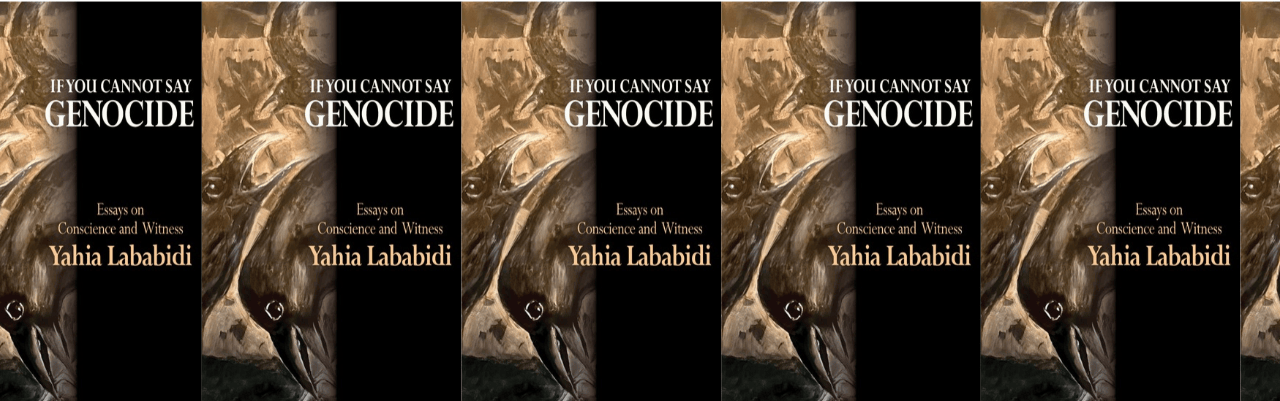
If You Cannot Say GENOCIDE. Essays on Conscience and Witness by Yahia Lababidi is now out from New Village Press.