
Stealing Sleep, Reclaiming Tomorrow
Stealing Sleep, Reclaiming Tomorrow
A Review of ‘The Sleep Thief’ by Ibtisam Azem
Reviewed by Britta Stromeyer
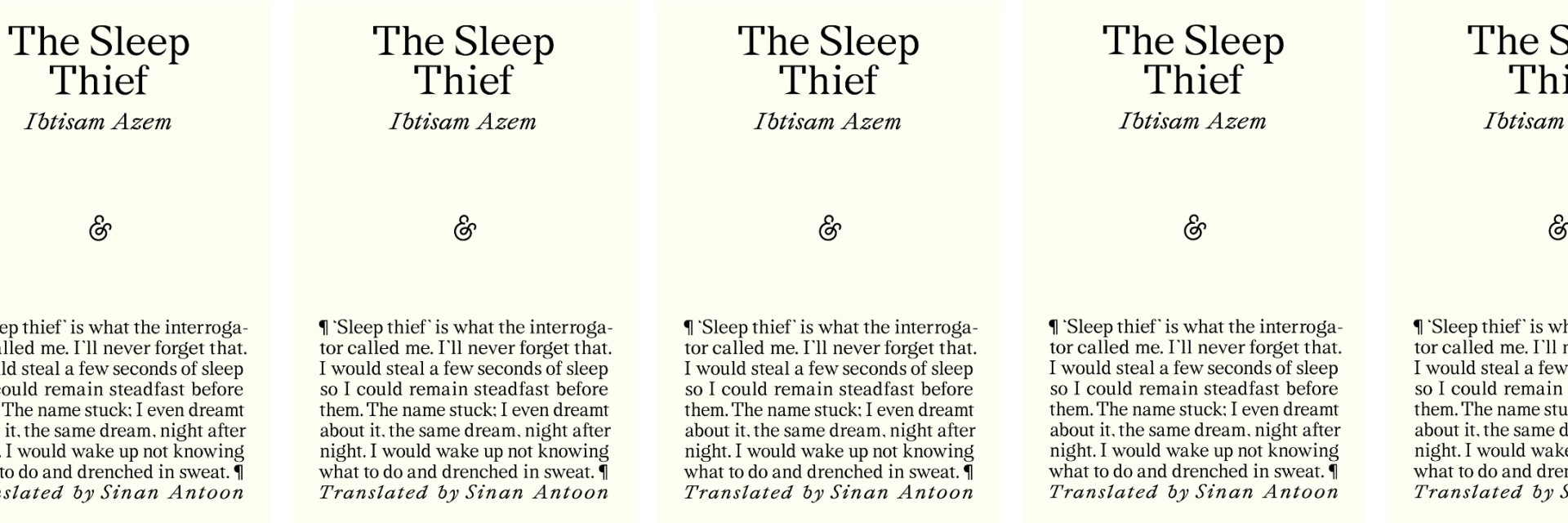
“I asked the gods to give me back my yesterday; they refused, except for one, the kindest among them. Upon me he bestowed the gift of stealing sleep so I could dream.” In the opening pages of The Sleep Thief by Ibtisam Azem (tr. Sinan Antoon), Palestinian protagonist, Gharib Haifawi, recounts how he was dubbed the “sleep thief” by his interrogators during his imprisonment. Deprived of rest, he stole fleeting moments of sleep just to endure the torment. Now, the label haunts him, resurfacing in recurring dreams and nightmares where gods grant him the power to rob others of their rest and underscores the inescapability of his trauma.
The novel is composed of interconnected vignettes and short chapters. Rather than following a strictly linear plot, Azem presents a mosaic of episodes from the life of Gharib Haifawi. Each chapter stands on its own, but together they build a layered portrait of his experiences, relationships, and inner world. Azem’s prose is poetic and surreal, blending mythic elements with rich interiority. The chapter’s dream logic sets the tone for the novel’s exploration of blurred boundaries between reality and imagination, memory and longing.
From the beginning, The Sleep Thief plunges readers into the novel’s emotional core: the heavy toll of survival, the ache of injustice, and the search for dignity in a world demanding impossible choices. Rendered in a phantasmagoric register, the story follows Gharib, born during the Six-Day War and living within the Israeli borders, as he comes of age, enters the resistance, navigates friendship and desire, and pushes back against established norms.
The narrative shifts between first- and third-person perspectives, blurring the boundaries of waking life and nightmare. Through its episodic structure, each brief chapter illuminates distinct glimpses of Gharib’s world—his family lineage, clashes with Israeli authorities, intimate relationships, and internal turmoil. The result is a narrative rich in symbolism, etymology, and cultural motifs that range from culinary traditions to the heavy symbolism of the archive.
Gharib’s nightly struggle mirrors the cyclical violence and loss woven into the Palestinian experience—a reality where the past remains unrecoverable, and the future stays fraught with uncertainty. Driven by Gharib’s recurring nightmare, the narrative pulls readers into a vivid landscape where rest, identity, and political defiance are inextricably bound—tracking a protagonist who longs to break free from suffocating labels, rails against the commodification of suffering, and dares to imagine a Palestinian identity that transcends sorrow.
Gharib’s very name—meaning “strange” or “foreign”—encapsulates the novel’s central preoccupation with alienation and the longing for belonging. The narrative is deeply rooted in the Palestinian experience of displacement, generational wounds, and the ongoing struggle to assert one’s identity against the threat of erasure and occupation. Here, Ibtisam Azem reveals how the simple act of naming transforms into a powerful statement of resistance.
Rather than romanticizing resistance, the novel exposes it as a complex and costly ordeal. Gharib’s protests, imprisonment, and confrontations with the Shin Bet are depicted with keen psychological depth. In this context, the “sleep thief”—the interrogator’s nickname for Gharib—serves as a powerful metaphor for the profound fatigue and relentless endurance required to survive under a constant state of surveillance, as Gharib reflects, “In Arabic, fear is a three-letter word. But they are big and rough letters. Fear lurks and eats me from within. It spreads everywhere inside me. It turns ordinary objects into burdens that carry meanings greater than they can hold.”
At its heart, the novel bridges the personal and the collective by treating Gharib’s family history as a microcosm of the Nakba and Naksa. Moments of domestic life—from inheritance disputes to quiet grief—are captured with emotional nuance, demonstrating how displacement and memory shape generational identity. At the same time, Azem offers a razor-sharp critique of how this Palestinian suffering is packaged for external consumption: “We are ghosts who only exist in our own imaginations.” This is most vividly realized in a surreal and haunting dream sequence where Gharib’s mother appears as an archive exhibit. Gharib is guided through a museum exhibit that displays artifacts and statues representing the traditions of the land’s original inhabitants. The most disturbing moment comes when he finds his mother, Alya, among the lifeless figures, baking bread as a museum exhibit—a striking image that exposes how history and human suffering are reduced to curated objects.
Intimacy, too, offers no simple escape; Gharib’s relationships, most notably with outspoken Hamsa, navigate a delicate line between tenderness and political tension. By grounding the narrative in moments of raw vulnerability and physical desire, the novel uses the private sphere to explore complex questions of personal agency under occupation.
Azem’s prose is lyrical, introspective, and daringly experimental. The narrative is suffused with linguistic play—exploring the etymology of names, the physical taste of words, and the power of language to both wound and heal. Sinan Antoon’s translation remains remarkably sensitive to these nuances, leaving a non-Arabic reader to feel confident that the musicality and emotional depth of the original have been faithfully preserved. While its fragmented and introspective nature may not appeal to every reader, the book’s brevity belies its immense weight, rendering it a vital contribution to contemporary Arabic literature in translation. Ultimately, The Sleep Thief is a haunting novel that lingers in the mind long after reading. Its exploration of exhaustion, estrangement, and the search for meaning under occupation is both specific to the Palestinian experience and universally resonant. In shining a light on the systemic subjugation and unrelenting occupation of the Palestinian people, it serves as a quiet call for dignity—a witness to a collective struggle and a hopeful plea that Palestinians everywhere may soon reclaim their stolen sleep, restore their tomorrows, and dare to dream freely once again.
Britta Stromeyer is a member of the National Book Critics Circle. Her writing appears in The Common, World Literature Today, Tupelo Quarterly, Beyond Words Magazine, Necessary Fiction, On the Seawall, Flash Fiction Magazine, Bending Genres Journal, Marin Independent Journal, and other publications. Britta has authored award-winning children’s books and holds an MFA from Dominican University, CA, an M.A. from American University, and a Certificate in Novel Writing from Stanford University.
More on Ibtisam Azem:
Novelist Ibtisam Azem on Absence, Presence, and Disappearance
With Ibtisam Azem at the Torino Book Fair
Ibtisam Azem’s ‘Book of Disappearance’ Makes 2025 International Booker Longlist