Lock-in Literature: ‘Eyes Shut’ by Rami Tawil
He walked the streets of the city every single day, living an entire life beneath his eyelids.
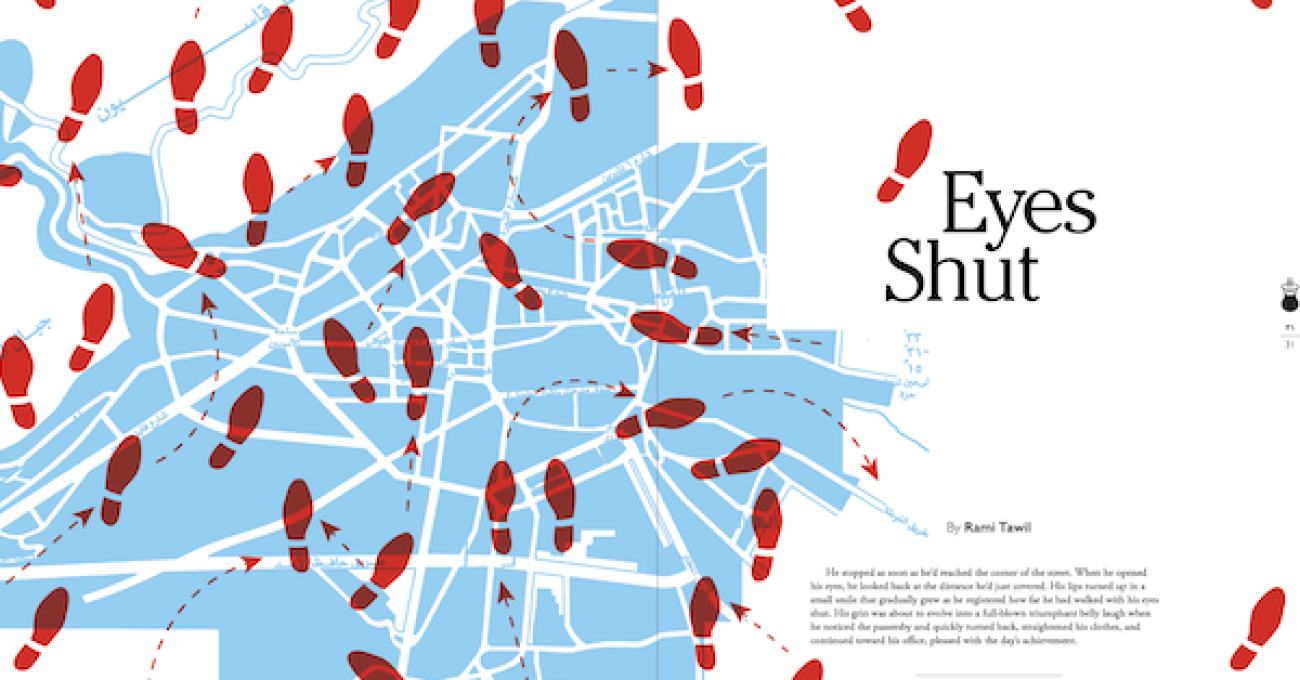
He walked the streets of the city every single day, living an entire life beneath his eyelids.

“On the surface, you might think it’s about the dire reality and all, but somehow his texts don’t bring you down. I don’t know how he does that.”
Our forty-seventh episode — “Tight Spaces” — talks about the ups and downs of recent online book events, as well as two novels that have recently appeared in English.
“You often spoke to me of a blind writer, who was fascinated by mazes and who smiled at even the most dreadful nightmares, while you walked, leaning on my arm—as if I would believe your talk about things that were receding before your eyes day by day.”

“Al-Yūsī’s orientation, and Morocco’s orientation at the time, was toward the south. It’s something that we don’t think about today.”
“To write a memory I gathered a memory / and to green the marshes I sprinkled friends/ over the salt marshes, and was at a loss/ with myself”
“Politics, Popular Culture and the 2011 Egyptian Revolution,” according to the University of Warwick’s Nicola Pratt, “is an open access digital archive exploring the Egyptian revolution and its aftermath through the prism of popular culture.”
“Three must-read books, translated mostly or entirely from the Arabic, have appeared free online from publishers in recent weeks.”
“It’s not quite the same as a purely autobiographical text, but it’s almost more interesting for that. They’re more like mini-essays. I do think that the work, for that reason, can be read by people who aren’t interested in seventeenth-century Morocco.”