
Classic Short Fiction: Issa Ebeid’s ‘Lady Ihsan’
In this classic short fiction from 1920, Issa Ebeid depicts a twice-divorced Egyptian woman as she examines the reasons society has made a happy, loving marriage impossible.

In this classic short fiction from 1920, Issa Ebeid depicts a twice-divorced Egyptian woman as she examines the reasons society has made a happy, loving marriage impossible.

In this episode of BULAQ, co-hosts Ursula Lindsey and M Lynx Qualey speak to Ahmed Gobba and Avery Gonzales, co-translators of Efflatoun’s 1993 memoir, The Memoir of Inji Efflatoun: From Childhood to Prison.

This October will see the release of Lebanese writer Souhaib Ayoub’s second novel, Le Loup de la famille (The Wolf of the Family), in Stéphanie Dujols’ translation. Originally published as Zi’b al-‘a’ila in 2024 by Hachette Antoine/Naufal, the French publication is an event for several reasons, not least because an exciting new voice has arrived in French.
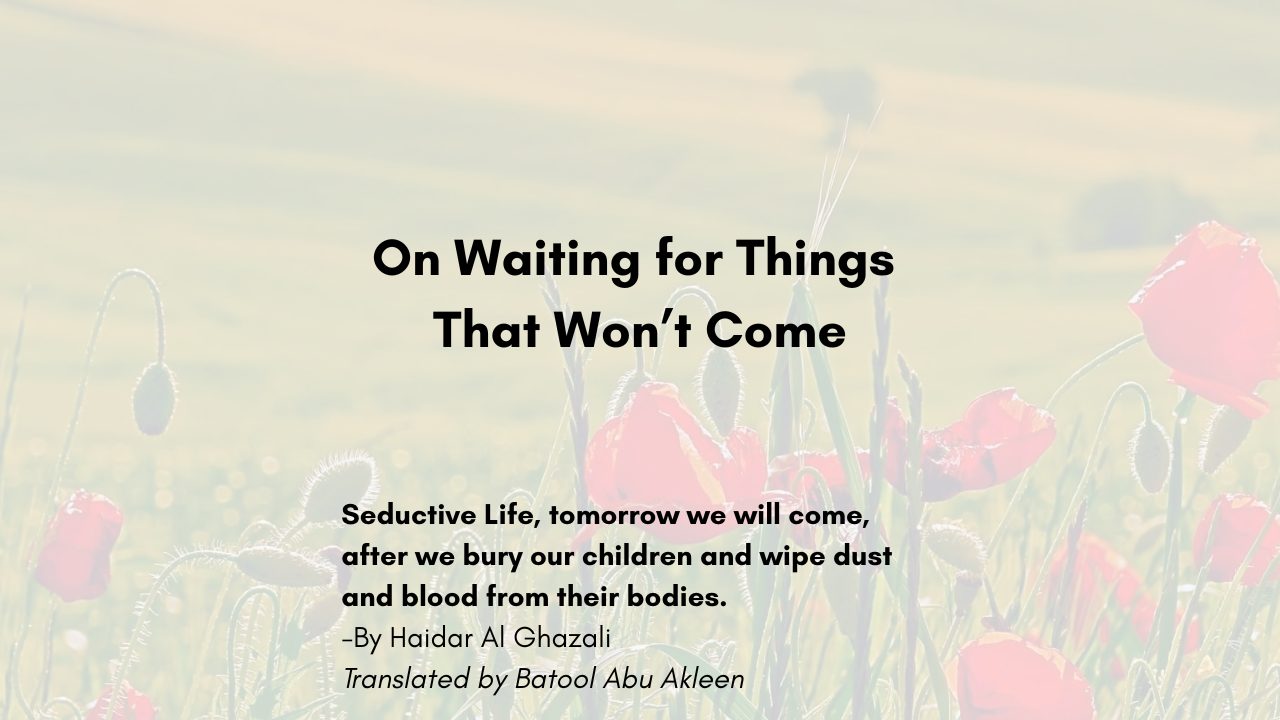
“Seductive Life, don’t disguise yourself. We know you too well. We see you in the airports, embracing the newborns and the newdeads. You carry their pain and plant bewilderment inside them. “

Last week, we ran Fatena Abu Mostafa’s “A Life That Doesn’t Know How to Live”; this week, we have another poem that opens: “I’m not okay / but I say it politely, / so no one thinks I’m asking for help.”

This month Ḥattā lā yatrukanī al-dawʾ (So the Light Won’t Leave Me), a collection of Nima Hasan’s poems written in the second year of the genocidal war on Gaza, was published by Al Nasher Publishing in Ramallah, Palestine. Below is Rania Jawad’s introduction to the book, in the author’s own translation, followed by two excerpts translated by Huda Fakhreddine.

Yesterday, the Banipal Trust for Arab Literature announced both the judging panel for the 2025 prize and the complete list of entries they will be considering for the 2025 Saif Ghobash Banipal Prize for Arabic Literary Translation, which is now in its twentieth year.

Nineteen-year-old Taqwa Ahmed Al-Wawi, a Palestinian writer and poet from Gaza, is an English literature student at the Islamic University of Gaza. Through her writing, she seeks to amplify Gaza’s voice and illuminate stories that are too often left untold. Here, she talks with ArabLit about her education, her writing, and the importance of poetry and speculative fiction.

In this poem, by Fatena Mostafa, the narrator endures, “not out of strength, / but because even collapse has grown dull.”