6 Authors Who Are Part of Yemen’s Literary History and Literary Resurgence
“Ongoing political turmoil may not bode well for Yemen, but if 2014 is any indication, the outlook for its national literary scene is a promising one.”

“Ongoing political turmoil may not bode well for Yemen, but if 2014 is any indication, the outlook for its national literary scene is a promising one.”

Wednesday morning, the MacArthur Foundation announced its list of “Genius Grants.” On the list to receive a no-strings-attached stipend of $625,000 is Libyan poet and translator Khaled Mattawa, who said he plans to use the money to further his translations and take on larger projects.

Translator Max Shmookler, who is currently co-editing a collection of Sudanese short stories with ArabLit contributor Raphael Cormack, continues to write, in a posts that first appeared on Baraza, about the challenges of bringing the “best” Sudanese literature into English.

Max Shmookler — who previously wrote about “How To Separate Mediocre, Good, and Great Stories for Translation” and his work in assembling a collection of Sudanese short stories — now explores the literary scene in Khartoum in a post that originally appeared on Baraza.

Emerging Sudanese author Mansour El Souwaim has received a number of plaudits. He was named one of the “Beirut39” in 2009, one of the top 39 Arab authors under 40, won the Tayeb Salih award for his second novel, and was selected to participate in the 2009 International Prize for Arabic Fiction nadwa. Souwaim has a new novel out, The Last Sultan, which Nassir Elsayed Elnour says “calls on us to rethink history.”
Translator Max Shmookler, who is currently co-editing a collection of Sudanese short stories with ArabLit contributor Raphael Cormack, explores the tension between what Sudanese readers think is a great story and the story that will appear “great” in English translation.
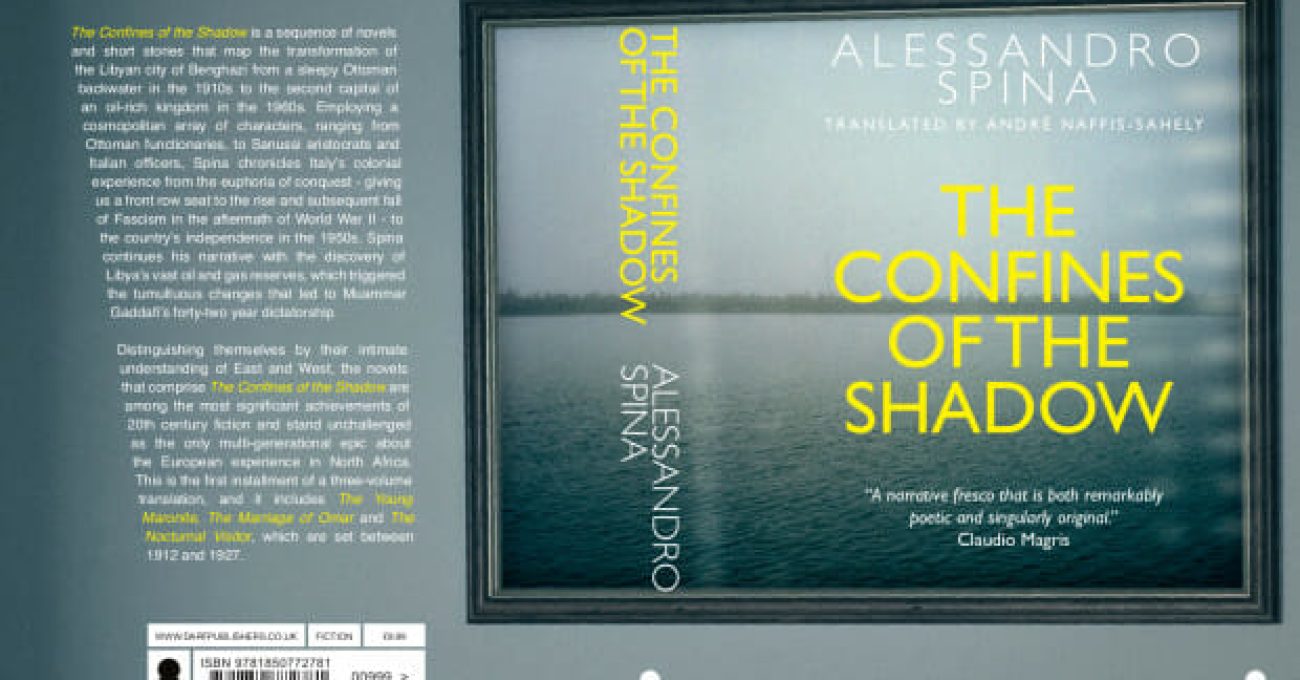
Alessandro Spina — the nom de plume of Benghazi-born author Basili Shafik Khouzam — died last year, two weeks before André Naffis-Sahely came to an agreement with a London publisher to translate his epic “The Confines of the Shadow,” which, Naffis-Sahely writes, “belongs alongside panoptic masterpieces like ‘Buddenbrooks,’ ‘The Man Without Qualities’ and ‘The Cairo Trilogy.'”
Mahmoud Darwish once wrote, of Gaza, “We are unfair to her when we search for her poems.” We are certainly unfair when we scrabble anywhere for poems, searching for aesthetic pleasure in others’ suffering. But here, poetry seems to have welled up from the need to speak, to create, to defy silence.

This is part two to eminent and pioneering translator Denys Johnson-Davies’ reflections on Tayeb Salih, after the passing of would’ve been Tayeb Salih’s eighty-fifth birthday. Here, Johnson-Davies returns to Salih’s work, particularly his most famous novel, and what stands as Salih’s real and lasting achievement.